
Key Takeaways
- VA loans allow eligible veterans to buy a home with zero down payment — no savings required.
- Veterans with any service-connected disability rating (even 10%) are fully exempt from the VA funding fee, which can save thousands of dollars at closing.
- If the funding fee was already paid before a disability rating was awarded, a refund may be owed — a detail most veterans never discover.
- VA loan entitlement never expires and can be reused after a prior loan is paid off.
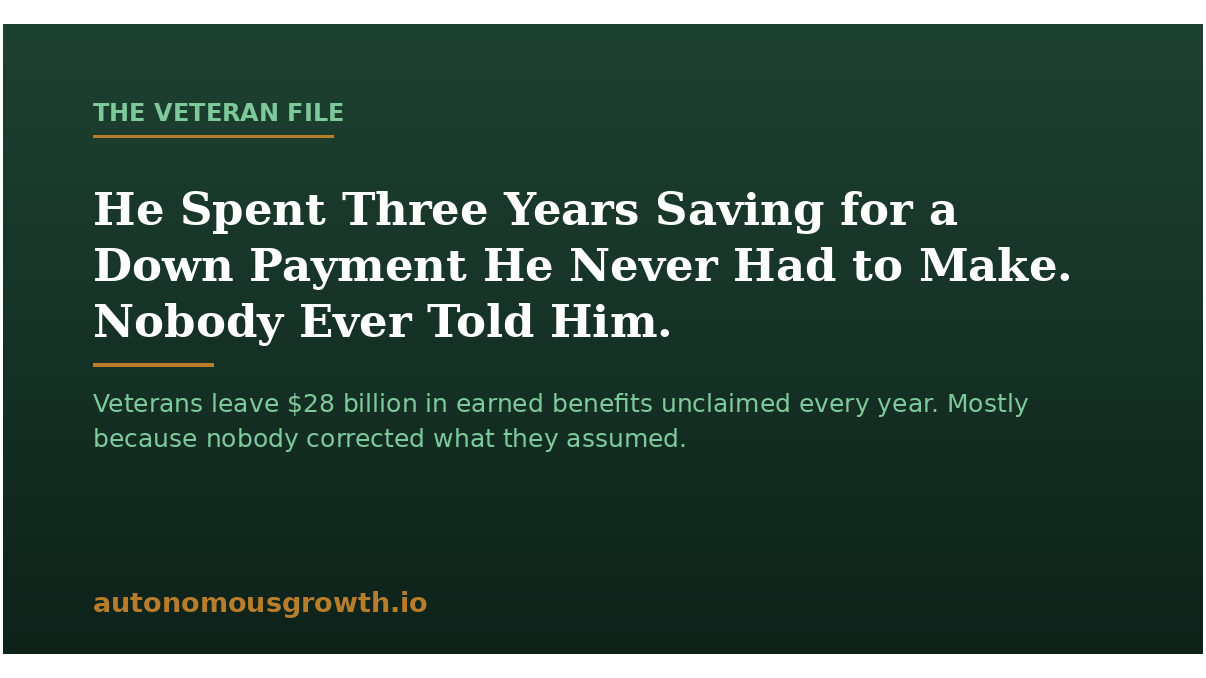
- Over $28 billion in VA loan benefits went unclaimed in 2024, largely because eligible veterans did not know what they qualified for.
Most veterans who skip the VA loan do not do it by choice. They skip it because someone told them the wrong thing years ago, and nobody ever corrected it. That single misunderstanding — usually something about needing a down payment — costs veterans thousands of dollars, years of waiting, and in many cases, the home itself.
$28 Billion in Unused VA Loan Volume Went Unclaimed in 2024
The numbers are hard to ignore. According to a Veterans United Home Loans analysis from October 2025, more than 58,000 VA loans went unused in 2024, representing nearly $28 billion in unclaimed loan volume.
The reason is not complicated. A Navy Federal Credit Union study found that 55% of veterans believe a VA loan requires a down payment. It does not. Veterans assume they do not qualify, so they never ask — they quietly set money aside and wait until the number feels right. Meanwhile, the benefit sits there, fully available.
Closing that awareness gap is central to the work done at Autonomous Growth, which helps mortgage professionals build visibility with veterans who are already searching — quietly, and usually expecting a no.
Zero Down Payment Is the Real Default
Zero down is the default on a VA loan, not a special exception. In 2025, 70% of VA purchase loans were made with no down payment. For eligible veterans, that is the norm.
How the VA Guaranty Makes It Possible
When a lender issues a VA loan, the U.S. Department of Veterans Affairs guarantees a portion of that loan. That guarantee protects the lender if the borrower defaults, which removes the need for a large down payment as a buffer. This is a direct result of military service — not a loophole or a promotional offer.
No PMI: The Hidden Monthly Savings
Conventional loans with less than 20% down require private mortgage insurance (PMI) — a monthly charge that protects the lender, not the buyer. VA loans carry no PMI requirement. Rocket Mortgage data from 2025 puts the median savings at roughly $10,600 over the life of a loan compared to a conventional loan with PMI. That gap shows up every single month, not just at closing.
Who Qualifies for a VA Loan
Service Requirements and Certificate of Eligibility
Eligibility generally requires one of the following:
- Minimum active-duty service (typically 90 consecutive days during wartime, or 181 days during peacetime)
- Six or more years of National Guard or Reserve service
- An honorable or qualifying discharge
- Surviving spouse status under qualifying conditions
Once eligibility is confirmed, the next step is obtaining a Certificate of Eligibility (COE) from the VA. This document tells lenders a veteran is entitled to use the benefit. A knowledgeable loan officer can pull it directly — it does not require extensive paperwork from the veteran.
No VA Minimum Credit Score, But Lenders Set Their Own (Typically 580-620)
The VA sets no minimum credit score. Individual lenders do, and most work within the 580-620 range for VA loans — lower than what most conventional loan programs accept. That is because the VA places significant weight on residual income: the money left over each month after all debts and living expenses are covered. A veteran without a perfect credit score but with solid monthly cash flow may still qualify where a conventional lender would decline.
The Funding Fee Exemption Most Veterans Miss
The VA funding fee is a one-time cost charged at closing. For a first-time VA loan with no down payment, it is typically 2.15% of the loan amount. On a $300,000 home, that is $6,450. It can be rolled into the loan rather than paid upfront, but for a large group of veterans, it does not apply at all.
Any Service-Connected Disability Rating Qualifies
Any service-connected disability rating — including 10% — fully exempts a veteran from the funding fee. There is no minimum threshold beyond that. Active-duty Purple Heart recipients and surviving spouses of veterans who died in service or from service-related disabilities are also exempt. Roughly one in three eligible veterans qualifies for this exemption, and most never know to ask.
Paid the Fee Already? A Refund May Be Owed
If a veteran paid the funding fee at closing and was later awarded VA disability compensation with a retroactive effective date covering the loan closing date, a refund of that fee may be owed. This is not widely advertised. A qualified VA loan officer or the VA directly can verify whether a refund applies — particularly for veterans who closed on a home before a disability claim was finalized.
VA Loan Rates and Long-Term Savings vs. Conventional
Beyond the funding fee and PMI savings, VA loans have historically carried lower interest rates than comparable conventional loans. Even a fraction of a percentage point compounds significantly over a 30-year term, translating into thousands of dollars in interest that never has to be paid. Combined with no PMI and no required down payment, the total financial advantage over a conventional mortgage is substantial for most eligible buyers.
What Minimum Property Requirements Actually Mean for Buyers
VA loans require that the property meet the VA’s Minimum Property Requirements (MPRs) — standards ensuring the home is safe, structurally sound, and sanitary. This occasionally creates friction when a buyer wants to purchase an older home or one being sold as-is. The MPRs exist to protect the buyer, not to create obstacles. A home that fails MPRs has a serious defect — and that is information any buyer needs regardless of loan type. Most move-in-ready homes pass without issue.
Your Entitlement Does Not Expire — and Can Be Reused
VA loan entitlement has no expiration date. A veteran who served in the 1990s and never used the benefit still has full entitlement available today. Entitlement is also restored when a prior VA loan is paid off or the property is sold. With full entitlement, there is no loan limit — the benefit scales with the home being purchased rather than capping at an arbitrary number. Veterans who used the benefit once and assume it is gone should verify their current entitlement status. It may be fully restored.
Check Your Exemption Status Before Your Next Step
Before starting any mortgage application, veterans with a disability rating should confirm their exemption status directly with the VA or a qualified VA loan officer. This one step can eliminate thousands of dollars in costs — and for those whose disability rating came after a loan closed, a refund may already be waiting.
The benefit was earned. Verifying entitlement and exemption status takes minutes and costs nothing — and it is the first thing any knowledgeable VA lender will check before anything else moves forward.
Autonomous Growth helps mortgage professionals get found by the veterans already searching for this guidance — visitautonomousgrowth. io to learn how they build that visibility across 10+ channels, run autonomously.
Autonomous Growth ( part of RReputatioNN )
109 Sint-Lenaartsesteenweg #1
1
Rijkevorsel
Antwerpen
2310
Belgium


